Ravens are returning to Connecticut

Ravens are returning to Connecticut:  Yes, ravens are returning to Connecticut. How long have they been gone? A long ass time, my friend – perhaps over a 100 years. Most likely our colonial forefathers did a number on them just as they had done with the wolf and the mountain lion. They were all viewed as either dangerous or pests.

It was ten, twelve years ago, when I first became aware that ravens were returning. It happened one morning the Farmington River, in New Hartford, Connecticut. Out of the forest came that unmistakable voice.  Instantly I knew what it was. In most minds, the mighty moose and the black bear are emblematic of the Great North Woods. If you have spent any time up there,however, you ‘d want to add the smell of balsam and the call of the raven. At least I would. So to hear a raven in Connecticut was very cool and totally unexpected. I tipped my hat toward the trees. Welcomed back Corvus corax. It good to have you in town.

After that, on occasion I would see one during the winter months in Wethersfield. Not many mind you, but here and there. Crows love to flock together; ravens prefer, however, to work solo or in pairs. Then a few days ago, I was reminded again. While fishing, I heard another raven speak. Yes, no question they are returning to Connecticut.

Visually separating them from crows is not always easy task. They are both similar in appearance, especially from a distance. Yet, there other ways to separate them. The common crow’s call is rather simple. The classic caw,caw,caw. Ravens, on the other hand, have a distinctive voice, delivering a mix of gurgles, croaks, and grunts, as well as high pitched alarms that carry for miles. On the wing the raven stand out too. Crows fly like an old man rowing, in a slow steady, straight ahead pace. Ravens are powerful aloft, true acrobats, soaring, diving, and even barrel-rolling. They are a hoot to watch. Lets hope they’re here to stay.
Posted in Wild Things | 6 Comments

Dry Flies can be a Problem

Dry Flies can be a Problem: Dry flies are a super part of our sport. Not one can deny that. But if you love dry flies too much, dry flies can be a problem.

I was on the river early this morning, working a team of nymphs through some promising water. Things were slow. Which was a bit surprising given the day before this spot had been red hot. But we all have experienced that stuff. Different days often supply different fishing.

Downstream from me a guy was working a dry fly. Awhile later he strolled off to explore new waters. I fished on. After an hour, he reappeared and struck up a conversation. It went like this.

Dry Flies can be a Problem

“Anything doing,” he inquired?

“Got one,” I replied.

“Been here six times this season already and have yet to catch a single fish!” he exclaimed with disgust.

“Did Okay here yesterday,” I added. “There’s fish here believe me.”

“Catch’em on nymphs,” he asked?

“Yeah, its the best method on this river.”

“I don’t fish nymphs,” he shot back. “a fish on a dry is more fun that a fish on a nymph. Don’t you agree?”

“Yeah…but a fish on nymph is more fun than no fish on a dry,” I answered.

“Maybe,” he said looking off.

Then asked me if I fished here often. I said no, adding I was just up from Florida for the summer. Next he wanted to know if I fly-fished the salt in Florida. Yes, I told him, inquiring if he fished in the salt too. His answer was no. I kind of figured that, but dug deeper.

“Why not,” I asked?

“Those saltwater flies aren’t really flies….their lures,” he informed me.

“Your Adams dry is a lure too, ” I told him.

At that he shrugged his shoulders and slowly walked off to his car. I guess I hadn’t made my point. Man oh man, dry flies can be a problem. Amigo, the bitter war between Halford and Skues lives on even today.


Posted in Fly Fishing in Freshwater | 2 Comments

Fly Rod & Reel Magazine is Done

Fly Rod & Reel Magazine is Done:  That’s right Fly Rod & Reel magazine is kaput. Here’s editor Greg Thomas’ blog confirming the magazine’s passing. Yes, the spring 2017 issue is their final breath. Sad news. It was a damn good read.

The magazine sprung to life in 1979 under the steerage of the late John Merwin (Who also started Fly Tackle Dealer later on.) Back then the publication was called Rod & Reel: The Journal of American Fishing, and addressed all forms of angling. Downstream, however, it changed moniker to Fly Rod & Reel, although exactly when that happened eludes me at the moment. (mid-eighties?)  But it was with the shift in focus to fly-fishing that the magazine gained traction. And with the passing of years, the masthead brought us names such as Silvio Calabi, Jim Butler, Stephen Bodio, and Joe Healy, to mention a few.

To earn its keep, Fly Rod & Reel separated itself from other publications on the sport by offering a more literary and philosophical approach. People such as author John Gierach and well-known conservationist Ted Williams graced the pages giving the magazine its distinctive voice. This slant bestowed a special status on Fly Rod & Reel, one that attracted avid reader. At the same time, however, others felt the magazine never supplied enough hardcore technical information. Oh well, you can’t please everyone.

Fly Rod & Reel‘s demise is yet another sign that the internet has altered the world. As Marshall McLuhan so aptly informed us half a century ago – “The medium is the message.”  And so it goes. In our digital age, print magazines are on the wane; while electronic magazines such as Midcurrent and The Drake thrive in cyber, waxing stronger by the day.  And in a similar fashion, the internet has had a significant effect on the number of fly shops across our land. Sadly they’re ebbing too, as buyers surf the web searching for deals. Perhaps all this upheaval will turn out for the best; we’ll just have to wait and see.

Update: The Digital Version goes down too

Posted in Outdoor Writing | 4 Comments

Is Euro-nymphing Fly-fishing?

Is Euro-nymphing Fly-fishing?: Heard something interesting today, from a reliable source. Yesterday, a conservation officer asked two anglers on Connecticut’s Salmon River  fly-fishing only area to leave. Why? They were euro-nymphing. Got you a tad puzzled? Okay, let me fill you in further.

In Connecticut, fly-fishing is defined as: “Angling with the use of a fly reel, fly rod, fly line, leader and a fly or flies….” The catch here, no pun intended, is the use of a “fly line”. Euro-nymphing doesn’t require a fly line on the water or even on the reel for that matter. That’s right, the whole rig could be mono-filament.

While this is the first time I’ve learned of a problem, I guess one might have seen it coming. Is Euro-nymphing fly fishing? Can you fly-fishing without casting a fly line? And if so, how does one separate it from spin-fishing?

Ready for more? Check this out. Here’s Pennsylvania’s fly-fishing definition. ” Fishing must be done with tackle limited to fly rods, fly reels and fly line with a maximum of 18 feet in leader material…” Notice anything?  Not only is Euro-nymphing done regularly without a fly line; the leaders can be in excess of 20 feet. Ahhh…the dilemma builds.

To learn more, I placed a call to Bill Hyatt – the Chief of Connecticut’s Bureau of Natural Resources. Besides being in charge of the state fisheries, Bill is a fly-fisherman, and I learned likes to euro-nymph. Perfect. So naturally he is interested in this matter. During our conversation he informed me that presently he has a bill in front of the legislature to change the regulatory definition of fly-fishing to include Tenkara -which doesn’t require a fly reel. Perhaps the Bureau will add more language to the bill to include euro-nymphing.

Update: I ended up researching this business in depth. No punt intended. I called just about every state and spoke with the fishing departments to ask how euro-nymphing fit into their regulations. It was a a very interesting journey, believe me. I published the results as “Fly-Fishing Outlaws”, in Fly Fisherman, Gear Guide issue, Oct 2017.


Posted in Fly Fishing in Freshwater | 2 Comments

Back to the Salmon River

Back to the Salmon River: I went back to the Salmon River today. (For the record I’m referring to the one in Colchester, Connecticut.) Conditions were fairly good. Water was down a hair, but running at a respectable 57 degrees. Nice temperature that. No the river wasn’t crowded. Loved that too. And get this: a decent hatch came off.

Back to the Salmon River

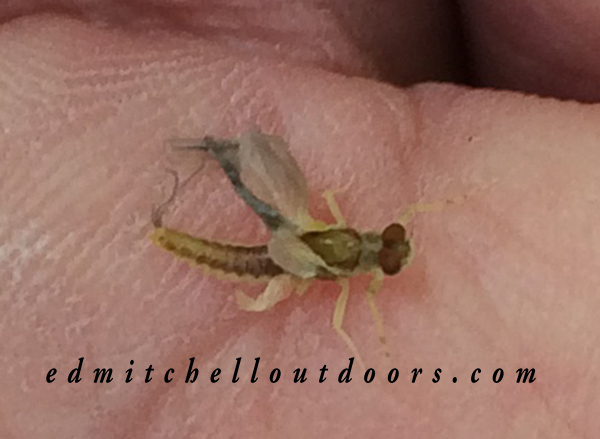
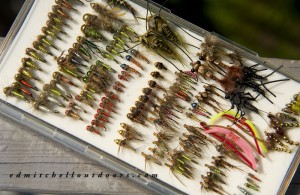
What was hatching? Well this river isn’t known for its abundant insect life, but mid-morning I saw a decent number of yellowish/ olive mayflies size 14/16 flying over the pool. There were upwards of 20 in the air at a time. Sulphurs? Likely. But they might also have been Epeorus vitreus. These two mayflies can come off together. Are very similar in appearance. And therefore hard to separate at times.

The mayflies today emerged in fast water, shooting straight skyward. Vitreus? Yet they had reddish eyes like Emphemerella dorothea. Ummmmm. Oh hell, take your choice. Either way, unfortunately, there wasn’t any real dry fly action. The duns spent zero time on the surface. Truth is I never saw one floating downstream? I did see a few small fish slashing at micro caddis, I believe. But no real risers.

   Okay, once again nymphs saved my day. Four nice rainbows clamped down on a size 18 zebra nymph, dangling off a size 16 bead-head caddis. None of the them were big trout. Nevertheless they fought well and I’m grateful for them. All in all, a good day on the water!


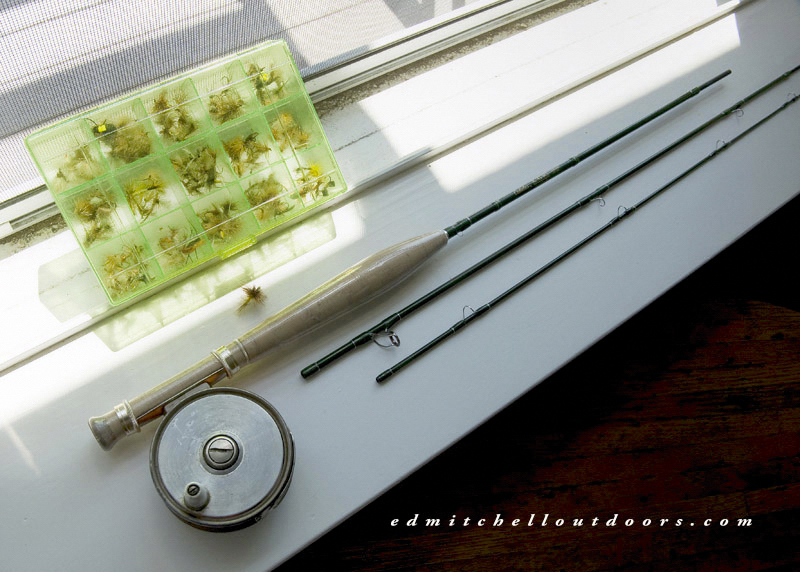
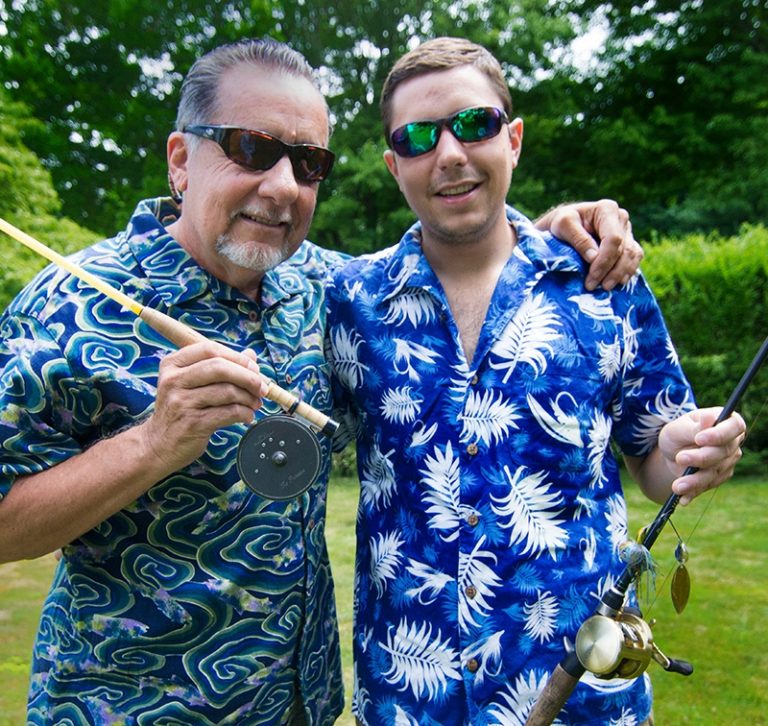
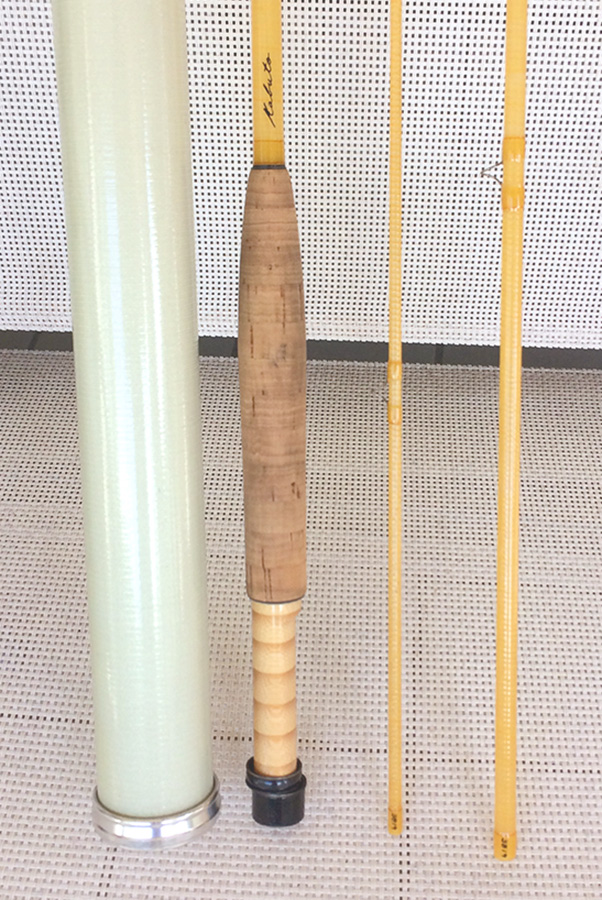
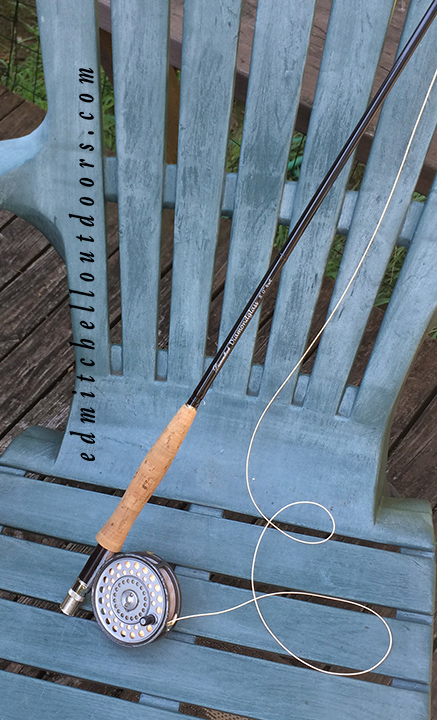
Now for an interesting aside. Ninety percent of the time I fish “glass” fly rods for trout, my favorite being an 8 foot Winston. Honestly I prefer “glass” rods for their action, especially in small water situations, where light lines and finesse rule the day. Typically I use one rod all day, but this time I brought along two – a Diamondglass and a Kabuto. In the morning I worked an 8 foot, 4wt. Diamondglass, then switching to a short, 3wt Kabuto later in the day.

What I noticed was how much the action of your rod affects how you fish. The “faster” Diamondglass (s-glass) had me fishing farther out and moving quicker along the stream. While the “slower” Kabuto (e-glass) made me fish closer in and at a more relaxed pace. Yes, your choice of fly rod truly has an effect, controlling the rhythm, and tempo of the day.

Posted in Fly Fishing in Freshwater | Leave a comment